← Back to work

02 — Case Study

Decode DFC — A behavioural UX case study on learner momentum

Designing momentum before designing interfaces — a behavioural study of why self-paced learners quietly fall off, and what would keep them going.

Behavioural UXUX StrategyService DesignLearningResearchSystems Thinking
Project
Decode DFC
Role
UX Researcher · Strategist
Duration
14-Day Hackathon
Team
4 Designers · Multidisciplinary
Scope
Behavioural UX · Service Design
Status
Proposal Accepted · Implementation in Progress

02Overview

Why did this project matter?

A learning cohort with the right content — and the wrong rhythm.

Decode DFC is a self-paced fellowship learning experience. The material was strong. Joiners were motivated. Yet week after week, consistency quietly slipped away.

01

Research

Interviews, surveys, and behaviour observations across active and inactive learners.

02

Behavior

The turning point wasn't confusion — it was quiet loss of momentum after week two.

03

Strategy

Design principles and interventions built to sustain motion, not add features.

03Research

What changed our understanding?

They didn't drop out. They quietly stopped starting.

Field interviews, learner surveys, behaviour observations, and secondary reading on habit formation. Every quote was mapped back to a decision — not a persona.

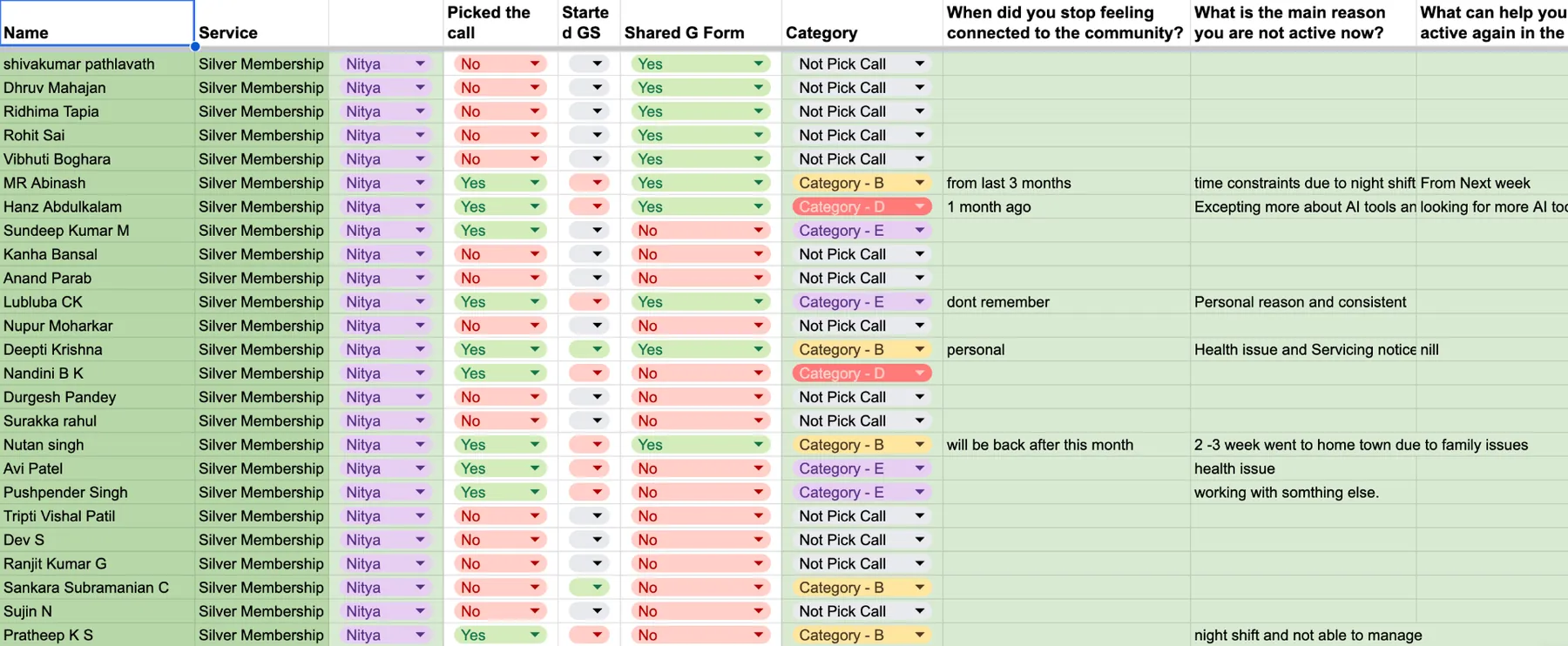
Interview planning and participant tracking spreadsheet

Interview planning and participant tracking used during primary research.

Artifact · Research Ops

14

Learner interviews

4

Methods used

22h

Conversation time

60+

Coded observations

Voices from the cohort

The first week felt exciting. By week three, opening the app started to feel like a task.

Learner · Cohort 2

I didn't know if I was behind or ahead. So I stopped opening it.

Learner · Cohort 1

Everyone else looked further along. I quietly stopped posting.

Learner · Cohort 3

Night shifts, family, life — I meant to come back. I just never did.

Learner · Cohort 2

Research findings

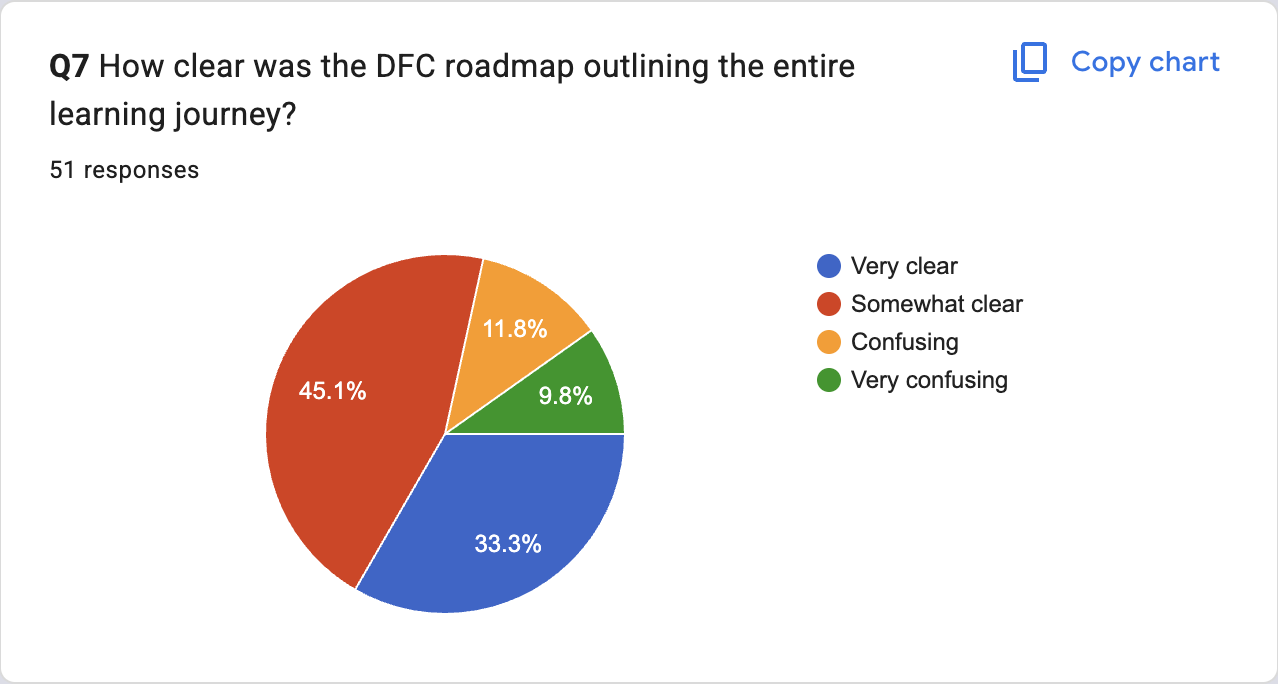
Survey: how clear was the DFC roadmap outlining the entire learning journey
Roadmap Clarity Survey · 51 responses

Insight

Learners understood the program goals. What they couldn't see was what came next in their own journey.

Barriers takeaway

Competing responsibilities and unclear next steps consistently reduced weekly participation — long before content difficulty became the reason.

Key Behavioural Insight

The problem wasn't poor content.
The problem was loss of momentum.

Motivation stayed high on day one. What eroded — quietly, week after week — was the small daily reason to return. Uncertainty grew. Confidence faded. Learners didn't quit; they simply stopped starting.

04Strategy

How did research influence our decisions?

We stopped designing features. We started designing motion.

Before recommending anything, we reframed the brief. Every principle below is traceable to a specific pattern in the research.

The reframe

How we got from research to recommendation

A traceable chain

01 · Research

14 interviews · surveys · behaviour observation

02 · Behaviour Pattern

Silent drop-off between weeks 2 and 4

03 · Root Cause

Loss of momentum — not loss of interest

04 · Design Principle

Design for Momentum · Reduce Uncertainty

05 · Recommendation

Strategic interventions, not more features

Design principles

Six principles to protect learner momentum.

01

Design for Momentum

Optimise for the choice to return, not the choice to start.

From research

Learners who felt daily motion kept going; the rest quietly stopped.

02

Reduce Uncertainty

Always answer 'where am I, and what's next?' — in one glance.

From research

'I didn't know if I was behind or ahead. So I stopped opening it.'

03

Celebrate Small Wins

Progress must be felt after every meaningful action, not only at the end.

From research

Modules that hid progress until completion had the sharpest drop-off.

04

Create Visible Progress

Show learners a rhythm they can recognise as their own.

From research

Behaviour clusters showed 'momentum keepers' relied on visible cues.

05

Support Reflection

Give learners a way to see their week — not just their tasks.

From research

Reflection moments were absent in every silent drop-off story.

06

Keep Learners Moving Forward

Every surface should hand off the next low-effort step.

From research

Learners who lost the 'next step' lost the week soon after.

The behavioural backbone

Momentum Model — the strategic backbone

A loop, not a funnel

01 · Cue

A tiny prompt tied to something the learner already does.

02 · Small Win

One action that finishes cleanly in under two minutes.

03 · Signal

A visible marker that yesterday counted toward today.

04 · Next Step

The obvious, low-effort thing to do tomorrow.

From research to ideas

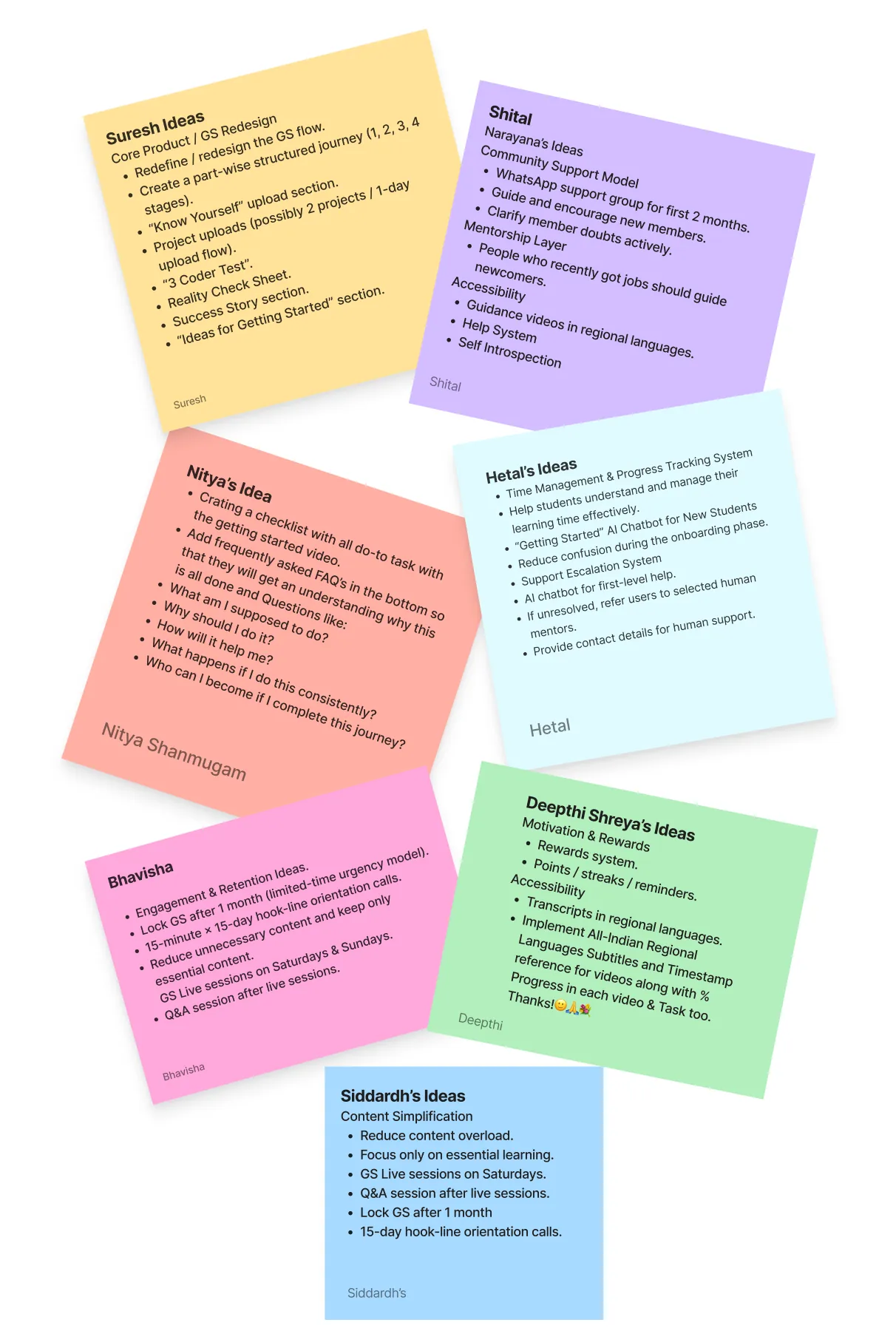
Collaborative ideation board with sticky notes from four designers

Ideation board — four designers translating research into intervention concepts.

Artifact · Synthesis

Where the strategy took shape

We didn't design features. We designed reasons to return.

Every sticky note traced back to a specific behavioural pattern in the interviews — and forward to one of the interventions on the next screen.

  • 01

    Daily Cue

    One small opening action, tied to a habit learners already had.

  • 02

    Micro-Wins

    Visible progress after every meaningful action — not only at module end.

  • 03

    Quiet Peer Signals

    Structured, low-stakes signals that replaced highlight-reel posts.

Editorial note

Ideas were only kept if they answered a specific quote from the research.

How the redesigned learner journey behaves

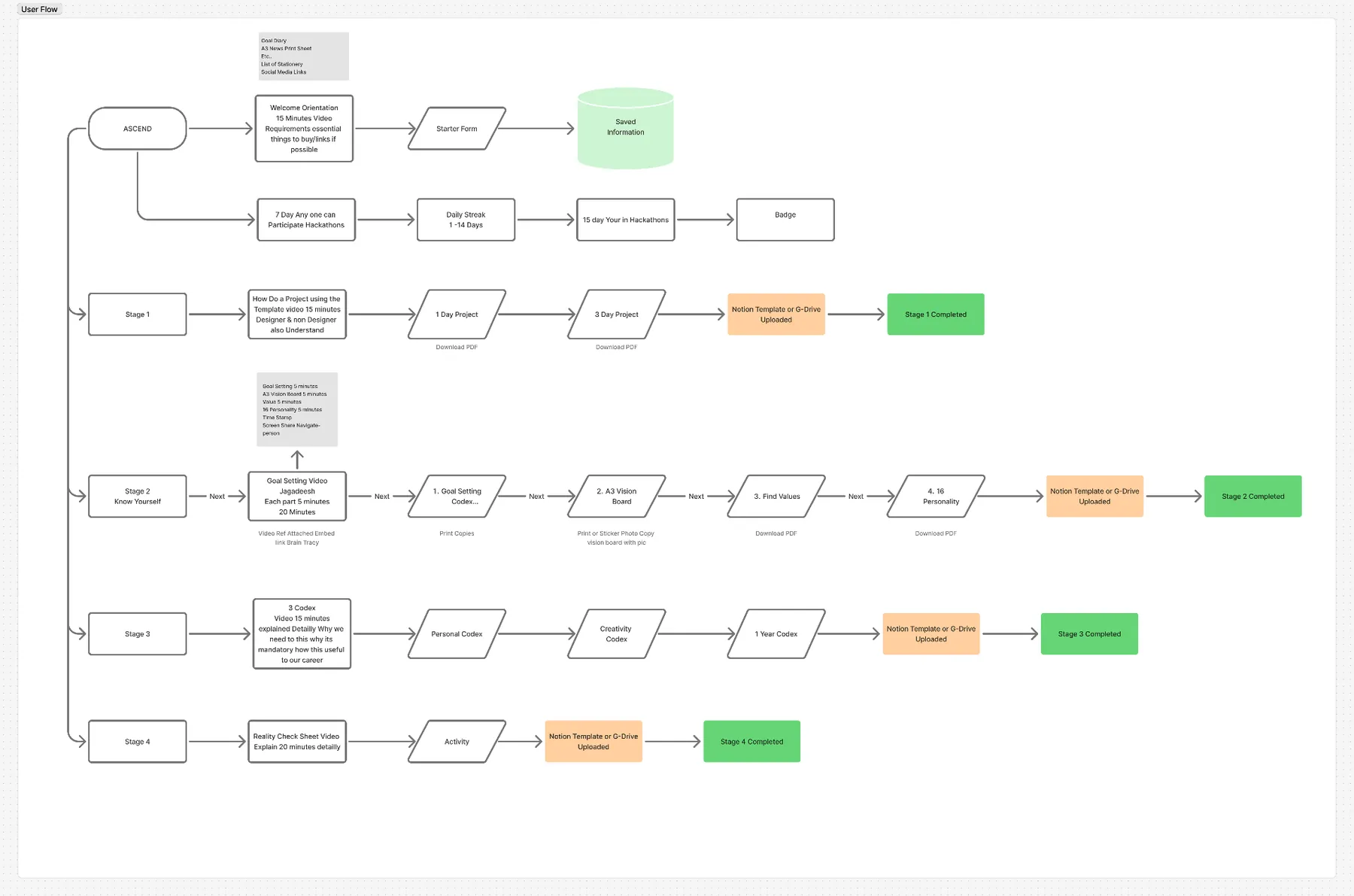
User flow diagram covering discovery through stage 4 completion

Learner flow — Discovery → Stage 4 → long-term impact, staged around momentum, not modules.

Artifact · Service Design

Behaviour insights, in the flow

Every stage answers a question a learner was already asking.

Where am I?

Orientation replaces guesswork before daily actions begin.

What's next?

One low-effort next step is always visible — never a menu.

Did that count?

Reality Check moments surface progress the learner can feel.

05Features

What changed because of those insights?

Four strategic interventions — not four features.

Each intervention traces back to a specific behaviour we observed, and forward to an outcome we can measure. Interface concepts stay supporting; the recommendation is the hero.

01 · Intervention

Implementation in Progress

Problem

Learners had no clear reason to open the app today.

Insight

Momentum lives in the day, not the week.

Recommendation

Daily Cue

A single opening cue that names one small action, under two minutes.

Expected impact

Learners feel a daily reason to return — not a weekly obligation.

02 · Intervention

Implementation in Progress

Problem

Progress was invisible until a module was fully complete.

Insight

Learners quit when they can't feel forward motion.

Recommendation

Micro-Wins

A visible win after every meaningful action, not only at the end.

Expected impact

Fewer silent drop-offs between weeks two and four.

03 · Intervention

Problem

Open peer channels rewarded the already-confident and silenced the rest.

Insight

'Someone like me kept going' beats a highlight-reel post.

Recommendation

Quiet Peer Signals

Replace public posts with structured, low-stakes signals of shared progress.

Expected impact

Lurkers convert into weekly, quiet participants.

04 · Intervention

Problem

Reminders were treated as noise, not care.

Insight

Contextual nudges outperform blanket notifications.

Recommendation

Earned Nudges

Send only after a missed cue — one message, tied to what the learner already committed to.

Expected impact

Higher open rate on the nudges that actually matter.

06Experience

How would learners experience those changes?

A cohort week, redesigned around returning.

No screens invented. Just the sequence of moments — cues, wins, signals — that a learner would move through if these recommendations went live.

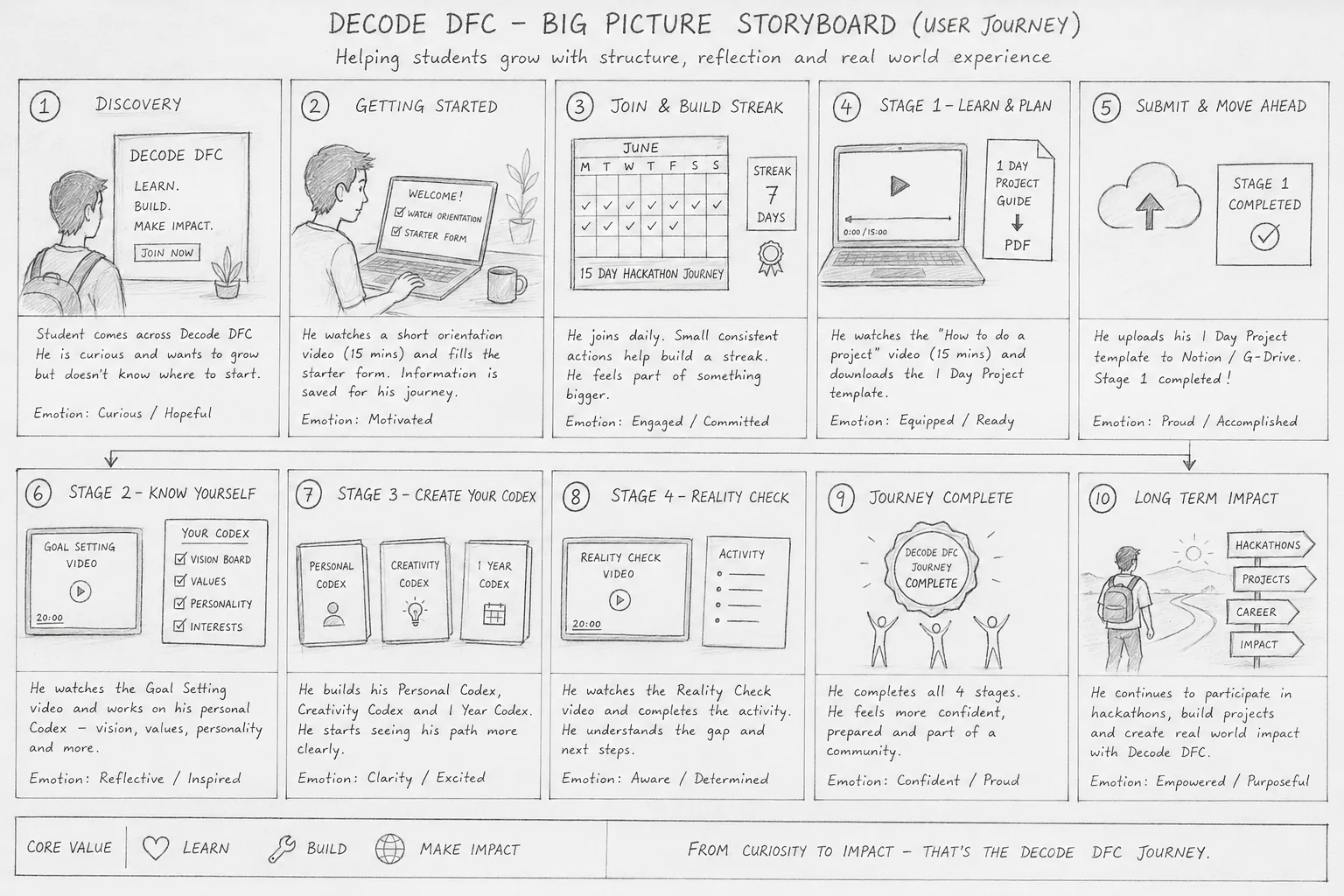
Hand-drawn storyboard mapping the learner's emotional journey from discovery to long-term impact

The Proposed Learner Journey

Artifact · Storyboard · 10 frames

Mapped as a story before it became a screen — each frame anchors one behavioural moment, from Discovery through Long-term Impact.

01 · Discover

Curiosity meets the program.

02 · Getting Started

Orientation replaces guesswork.

03 · Join & Build Streak

Daily cue turns into a rhythm.

04 · Stage 1 — Learn & Plan

First real task, kept short and finishable.

05 · Stage 1 Completed

The first felt win.

06 · Know Yourself

Reflection makes learning personal.

07 · Create Your Codex

Learners author their own path.

08 · Reality Check

Progress is surfaced, not assumed.

09 · Journey Complete

Momentum turned into identity.

10 · Long-term Impact

The learner keeps going — without the app.

Confusion → Confidence · emotion curve

Confusion

Week 1

Feels like

Motivated but unsure where the daily rhythm lives.

Design move

A single opening cue names the daily action, not the weekly goal.

Commitment

Week 2

Feels like

First real friction — life gets in the way of long sessions.

Design move

Micro-wins keep progress alive on the busy days.

Consistency

Weeks 3–4

Feels like

The critical window where silent slippers used to disappear.

Design move

Earned nudges + peer signals catch drift before it becomes a gap.

Confidence

Weeks 5–6

Feels like

The learner starts describing themselves as 'the kind of person who shows up'.

Design move

Momentum dashboard reflects identity back to them.

07Validation

How will we know this worked?

Proposal accepted. Implementation underway.

We're not claiming outcomes we haven't earned. Instead, we've defined the framework by which success will be measured once the interventions are live.

Status

Proposal Accepted

The behavioural reframe and design principles were endorsed by cohort leads.

Status

Implementation in Progress

Implementation Underway

Daily Cue and Micro-Wins are being built into the next cohort cycle.

Status

Success Metrics Proposed

Five outcome measures, each linked to a specific intervention.

How success will be measured

A framework, not a scoreboard.

01

Retention

Learners who remain active across the full cohort — not just week one.

Tied to

Daily Cue · Micro-Wins

02

Weekly Participation

The share of a cohort returning on at least three days each week.

Tied to

Daily Cue · Earned Nudges

03

Mentor Engagement

How often mentors are pulled into learning moments, not admin ones.

Tied to

Quiet Peer Signals

04

Activity Completion

Meaningful actions finished — measured continuously, not only at module end.

Tied to

Micro-Wins

05

Learner Confidence

Self-reported sense of 'I'm keeping up' across weeks two, four, and six.

Tied to

Momentum backbone (all four interventions)

These are proposed measures, not reported outcomes. They'll be baselined against the current cohort before the interventions go live.

08Reflection

How did this project change the way I think as a designer?

I stopped starting with screens.

Decode DFC pushed me from 'what should this interface do' to 'what should this week feel like' — a shift in altitude I want to carry into every future project.

01

What challenged me

Holding back on interface ideas long enough to see the real behavioural problem. Every instinct wanted to jump to a screen.

02

What changed my thinking

That the most valuable move a designer makes is often invisible — reframing the problem so the right solution becomes obvious.

03

How this influences my future work

I now start every project by asking what behaviour we're trying to change, and only then what surface we might design.

Collaborative process

14-Day Design Sprint6 Team MembersProposal AcceptedImplementation Underway
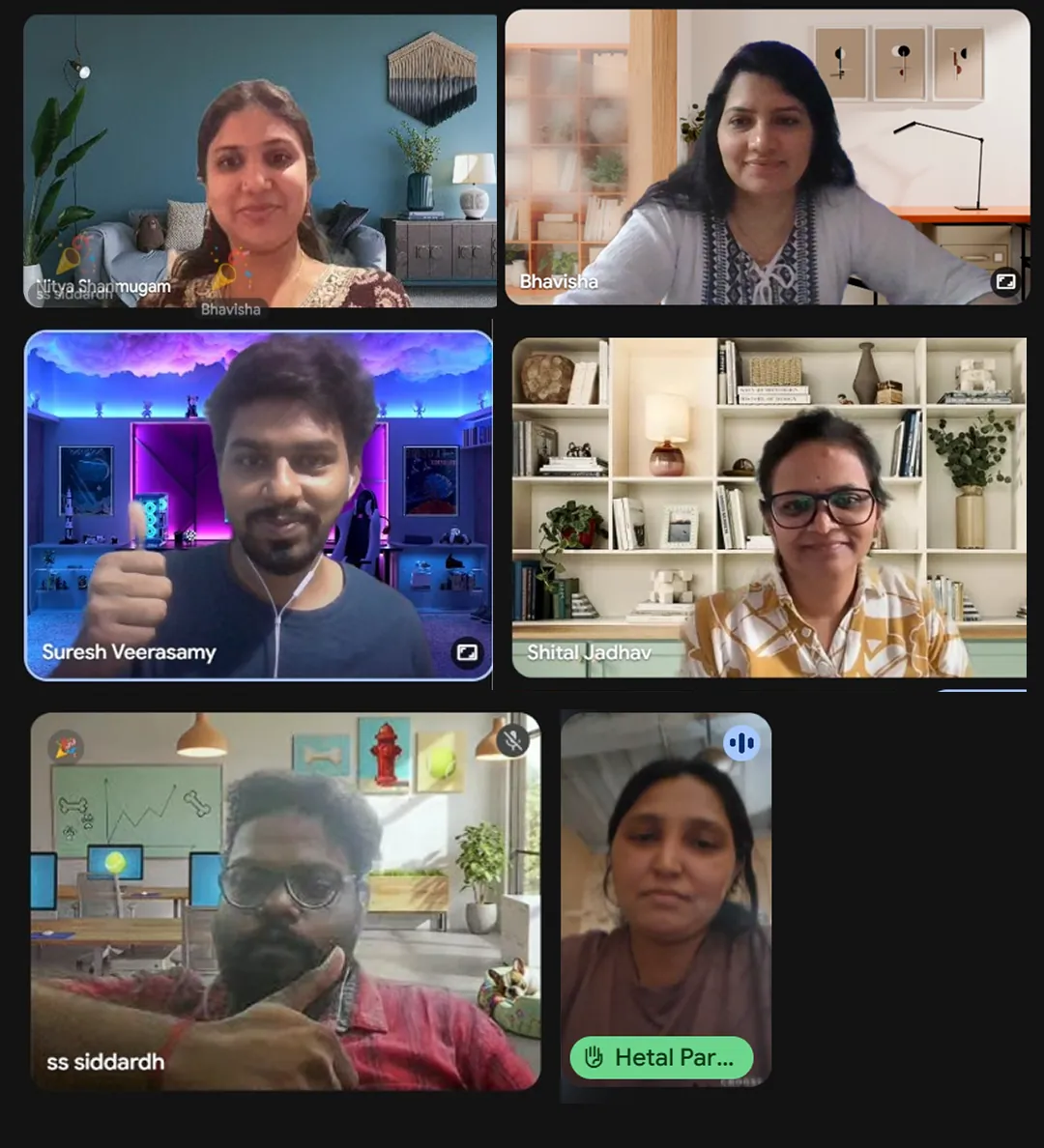
All six team members in a collaborative remote design session — Mars Monarchs

Six teammates, one shared behavioural lens.

Mars Monarchs · Working session

A multidisciplinary team held the research together — my contribution led the behavioural framing, momentum model, and the reframe that shaped the final proposal.

A closing thought

The most impactful design decision wasn't creating a better interface.
It was discovering the right problem to solve.

Great learning experiences aren't built by adding more content — they're built by helping people keep going.

End of case study · Decode DFC · 2025

Next project

Museum of Spices

A multi-sensory museum experience translating the stories, culture and history of spices into space, sound and touch.

🚧 Coming Next · In ProgressBack to all work

— Contact

LET'S DESIGN
MEANINGFUL
PRODUCTS
TOGETHER.

— Get in touch

Open to Product Designer roles

Hi, I'm Nitya — a Product Designer focused on Fintech, HealthTech, and Enterprise SaaS. If you're hiring or want to talk about a project, the fastest way is email.

Resume
Usually replies within 24 hoursBengaluru · Remote or onsite
NityaProduct DesignerUX ResearcherDesign ThinkerHuman-CenteredAccessibilityInteraction DesignDesign SystemsResearchNityaProduct DesignerUX ResearcherDesign ThinkerHuman-CenteredAccessibilityInteraction DesignDesign SystemsResearch
© 2026 Nithya ShanmugamDesigned & built with care.